


How to Choose the Perfect Pedalboard Size: A 2026 Guide
Choosing the right pedalboard size isn't just about how many pedals you own. You also need to consider their dimensions, cable connections, power supply and how much room you want for future additions.
Too small, and you'll run out of space. Too big, and you'll end up carrying more than you need.
This guide will help you find the right pedalboard dimensions for your setup, whether you're building your first board or upgrading an existing one.
Pedalboard Sizes & Dimensions
Not sure what size pedalboard you need? Here's a quick comparison of Aclam's standard Smart Track® pedalboard dimensions, from compact single-row boards to larger setups.
| Model | cm | inches | Pedals* |
|---|---|---|---|
| XS1 | 42 × 15 | 16.5 × 5.9 | 3–4 |
| S1 | 59 × 15 | 23.2 × 5.9 | 4–5 |
| XS2 | 42 × 30 | 16.5 × 11.8 | 5–7 |
| S2 | 59 × 30 | 23.2 × 11.8 | 8–10 |
| L2 | 82 × 30 | 32.3 × 11.8 | 10–14 |
*Pedal capacity depends on pedal dimensions, layout, connectors and mounting system.

Now let's figure out which size works best for you.
1. How Many Pedals Do You Have (and How Many Will You Add)?
Start by counting the effect pedals you currently use. But don't stop there. Think about how your setup might evolve over time.
A tuner, compressor, overdrive, distortion, delay and reverb can quickly fill a pedalboard. And if you enjoy experimenting with new sounds, chances are you'll add another pedal sooner or later.
Also, remember that not all pedals take up the same space. Five compact pedals might fit comfortably on a board that struggles to accommodate three larger effects.
Our tip: If you're planning to expand your setup, consider leaving room for one or two additional pedals. But don't go unnecessarily big, especially if you regularly carry your board to rehearsals or gigs.
2. How to Measure Your Ideal Pedalboard Size
Before choosing a pedalboard, try this simple exercise. All you need is your pedals, a flat surface and a measuring tape.
Step 1. Arrange your pedals
Place your pedals on a table or on the floor, just as you'd like them arranged on your pedalboard. Try different layouts until you find one that feels comfortable and practical.
Step 2. Leave room for cables and connections
Remember that pedals need more space than their enclosures alone. Make sure to account for patch cables, power connectors and any mounting hardware you'll be using.
Pedals with side-mounted jacks may require additional clearance, depending on the connectors you use.
Step 3. Plan your power supply
Think about where your power supply will go. If you're planning to mount it underneath the board, check the available clearance. Otherwise, include it in your layout measurements.
Step 4. Measure the total width and depth
Once you're happy with your arrangement, measure the total width and depth of your setup, including the space needed for cables and mounting hardware.
Compare those measurements with the pedalboard dimensions in the table above.
Pro tip: Don't rely only on the external dimensions of a pedalboard. Check the usable mounting area, rail layout and spacing required by your pedal fasteners.
3. Where Will You Be Playing?
The right pedalboard size also depends on where and how you play. A setup that works perfectly in your home studio might be less convenient when you're carrying it to rehearsals or gigs every week.
Home or Studio
If your pedalboard stays in one place most of the time, portability may not be your biggest concern. You can prioritize having enough room for your effects, power supply and future additions.
A medium or large pedalboard can be a practical choice for setups with multiple effects or more complex signal chains.
Rehearsals and Live Gigs
If you regularly carry your gear to rehearsals or concerts, think about the total weight and dimensions of your setup, including the pedals, power supply and case.
A compact pedalboard that's easy to transport and quick to set up might be more useful than a larger board with unused space.
Touring and Frequent Travel
When you're travelling frequently, every centimetre matters. Consider how easily your pedalboard fits into your vehicle, how much it weighs and how you'll protect it during transport.
A softcase can be convenient for everyday transport, while a suitable hard case may offer additional protection when equipment is being transported with other gear.
Our tip: Choose the smallest pedalboard that comfortably fits your setup and your realistic plans for expansion. More space isn't always better, especially when portability matters.
4. Find the Right Pedalboard for Your Setup
Now that you know how much space you need, let's look at which pedalboard size might work best for your setup.
Small Pedalboards: XS1 & S1
Best for compact, single-row setups. If you rely on just a few essential effects, a small pedalboard can give you everything you need without unnecessary bulk.
The XS1 is our most compact standard model, while the S1 offers extra length for a few more pedals or larger enclosures. Both are practical options for guitarists and bassists looking for a portable setup.


Explore compact Smart Track pedalboards →
Medium Pedalboards: XS2 & S2
A balance between pedal capacity and portability. Two-row pedalboards give you more flexibility to arrange different pedal sizes and create a practical signal chain.
The XS2 is a compact two-row option, while the S2 provides additional space for more extensive setups. They're worth considering if a single row isn't enough.


Large Pedalboards: L2
For more extensive effects setups. If you use several drives, modulation pedals, delays, reverbs and utility effects, a larger surface gives you more freedom to organize everything.
The L2 is our largest standard pedalboard size. It's designed for players who need more space and don't want to compromise on their setup.

Need something different?
If none of the standard sizes fits your setup, you can explore a custom Smart Track® pedalboard configuration.
5. Cable Routing & Pedal Mounting: Details That Matter
Two pedalboards with the same dimensions can offer very different setup possibilities. The way you route your cables and secure your pedals can make a big difference to the space available.
Top Routing vs. Free Routing
When choosing a pedalboard, think about where you want your cables to run. Aclam Smart Track® pedalboards are available in two routing configurations:
Top Routing: Designed for players who prefer organizing their cable connections on the top side of the pedalboard, keeping everything accessible.
Free Routing: The spaces between the rails allow cables to pass between the top and underside of the board, offering more flexibility for cable management.

Neither configuration is automatically better. The right choice depends on your pedals, connectors and the way you prefer to organize your setup.
How Will You Secure Your Pedals?
Velcro is a common way to attach effects pedals, but it's not the only option.
Aclam's Smart Track® system uses mechanical Fasteners to hold your pedals securely in place, without applying adhesive strips to their enclosures.
This keeps your pedals free from adhesive residue and lets you rearrange your setup without replacing Velcro strips. However, remember to leave enough clearance around each pedal for the Fasteners and cable connectors.
Our tip: Before choosing a pedalboard, check how your pedals will be mounted and where the cables will run. A good layout isn't just about fitting everything in, but also about keeping your setup practical and easy to use.
6. Building Your First Pedalboard?
Once you've figured out the right size for your setup, there's one more thing to consider: what do you actually need to get started?
Besides the pedalboard itself, you'll need a way to transport it and a reliable system to secure your pedals. Getting everything together from the beginning can make building your setup much easier.
Meet the Smart Track® Starter Bundles
We've put together everything you need to get started with the Smart Track® system in one convenient kit.
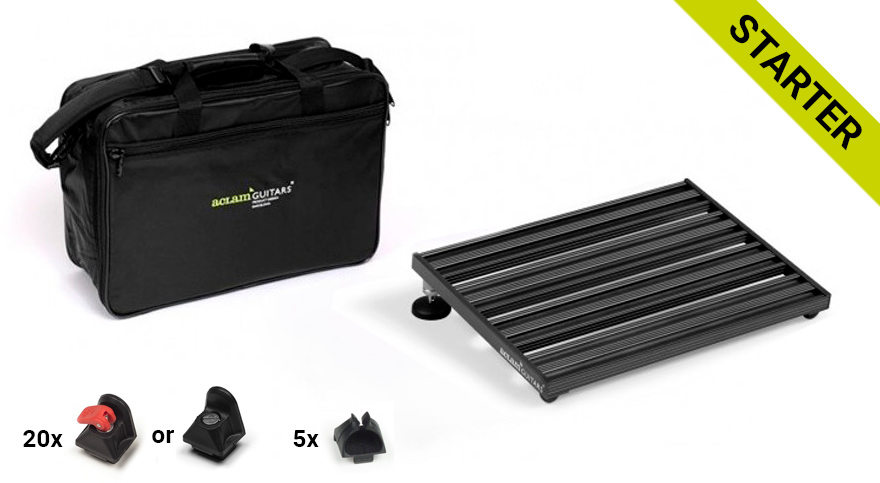
Each XS2 Starter Bundle includes:
- 1 Smart Track® XS2 Pedalboard
- 1 Softcase
- 20 Fasteners (Standard or Fast Fasteners)
- 5 Tidy Cables Duo
Now available with your choice of Top Routing or Free Routing.
No Velcro required. Just your pedals, securely mounted and ready to play.
Not starting from scratch? You can also explore individual Smart Track® pedalboards in different sizes.
7. Frequently Asked Questions About Pedalboard Sizes
What size pedalboard do I need for 5 pedals?
It depends on the dimensions of your pedals. Five compact effects might fit on a single-row pedalboard, while larger enclosures may require a two-row setup. Aclam's S1 and XS2 are two options worth considering. Always check the layout with your connectors before choosing.
What size pedalboard do I need for 10 pedals?
For a setup with around 10 standard-sized pedals, a medium-to-large pedalboard is usually a good starting point. Aclam's S2 and L2 models offer different amounts of space, depending on your pedal dimensions, arrangement and plans for expansion.
What are the dimensions of a standard guitar pedal?
There's no universal standard size. Compact pedals, such as many Boss-style effects, often measure approximately 7 cm wide and 13 cm long (2.8 × 5.1 inches). Mini pedals can be considerably smaller, while wah pedals, multi-effects and larger enclosures need much more space. Always check the dimensions of your specific pedals.
How much space should I leave between pedals?
There's no fixed measurement that works for every setup. The space you need depends on the position of your input and output jacks, patch cable connectors and mounting method. Test your layout with your actual cables before deciding on a pedalboard size.
Should I buy a bigger pedalboard than I currently need?
Leaving room for one or two additional pedals can be useful if you expect your collection to grow. However, a larger pedalboard also means more weight and less portability. Choose a size that suits your current setup and your realistic plans for expansion.
Can I mount my power supply underneath a pedalboard?
Many pedalboards allow power supplies to be mounted underneath, but compatibility depends on the available clearance, the dimensions of your power supply and the mounting accessories. Check these details before purchasing.
Ready to Find Your Perfect Pedalboard?
Now that you know how to measure your setup and compare pedalboard sizes, you're ready to find the right fit. Explore the Smart Track® range and choose the pedalboard that works for your pedals and playing style.
EXPLORE SMART TRACK PEDALBOARDS
Still have questions? Get in touch and we'll help you find the right setup.


. what a great blog, this writter who wrote this article it's realy a great blogger, this article so inspiring me to be a better person. Please visit things to do
Thanks!
Great post guys! Just one point for beginners to consider - rows. You probably want your board wide enough to accommodate all your frequently used pedals (boost for example) on the front row for quick stomping and then the less used pedals (maybe you use phase for one song in a set) on the back row. I personally prefer a wider but shallower board if I can - usually 2 rows of pedals :)